
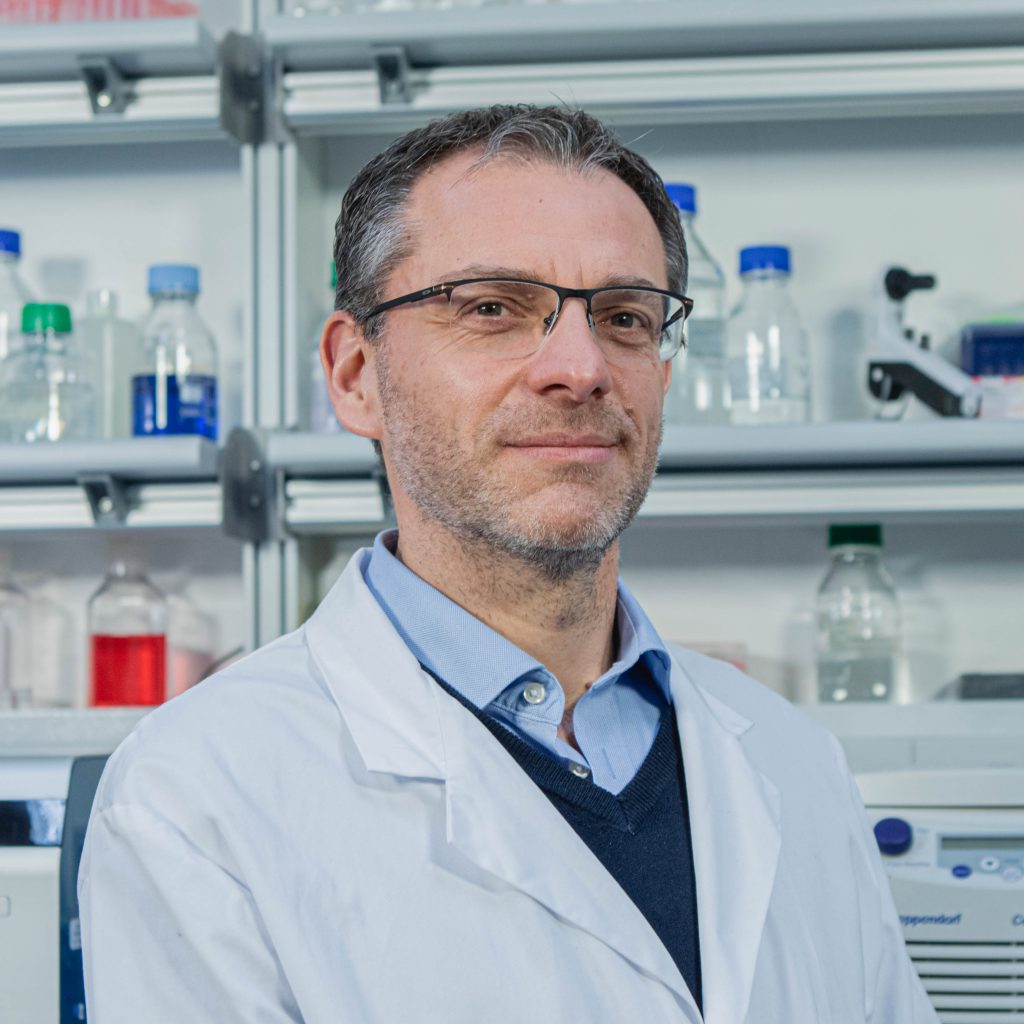
Antonio Inforzato graduated in Chemistry (Biological Chemistry Curriculum) at the University of Naples Federico II (2001) and obtained a PhD in Immunology from the University of Rome Tor Vergata (2006). He completed his training in Immunology at the Leiden University Medical Center (Leiden, The Netherlands; 2005) and the Medical Research Council (MRC) Immunochemistry Unit, University of Oxford (Oxford, UK; 2006), and in Biochemistry/Biophysics at the Faculty of Life Sciences, University of Manchester (Manchester, UK, 2006-2009).
He was appointed Assistant Professor of Healthcare Professions and Medical Technologies (MED/46) at the University of Milan (2014-2017), Assistant Professor of Biochemistry (BIO/10) at Humanitas University (2018-2021), and currently holds a position of Associate Professor of Biochemistry (BIO/10) at Humanitas University (since March 2021). Antonio has served at Humanitas Research Hospital (HRH) as Senior Scientist in the Laboratory of Immunopharmacology (2009-2022), and Head of Unit in the Laboratory of Cellular and Humoral Innate Immunity (since 2023).
He authored 60 publications, and 2 book chapters indexed in Pubmed, 28 proceedings, and 1 commentary, with average impact factor of 7.6 and h-index of 32 (Scopus) & 34 (Google Scholar). He is co-inventor of 2 patents, and, at present, lectures in Biochemistry at Humanitas University where he coordinates two integrated courses of the Medical and Medtec Schools.
Antonio’s scientific interests primarily focus on structure/function of soluble components of the innate immune system in infectious and degenerative diseases, and tissue homeostasis. A major focus of his Unit is on the long pentraxin PTX3, as a paradigm of the innate humoral response, for which he supervises and coordinates the following lines of research:
- characterization of the structure of PTX3 and its complexes with complement and extracellular matrix proteins;
- identification of new functional spaces for the soluble effectors of innate immunity in bone physiology (e.g., bone turn-over) and pathology (e.g., osteomyelitis);
- definition of the role/s of PTX3 and other matrix molecules (TSG-6, I-alpha-I, FGF2) in the remodeling of the hyaluronic acid extracellular matrix in inflammatory (e.g., angiogenesis) and inflammatory-like (e.g., ovulation) processes;
- assessment of the molecular mechanisms underlying the functional cooperation between pentraxins and the complement system in the immune response to fungal infections (e.g., invasive aspergillosis) and immunodegenerative diseases (e.g., age-related macular degeneration).